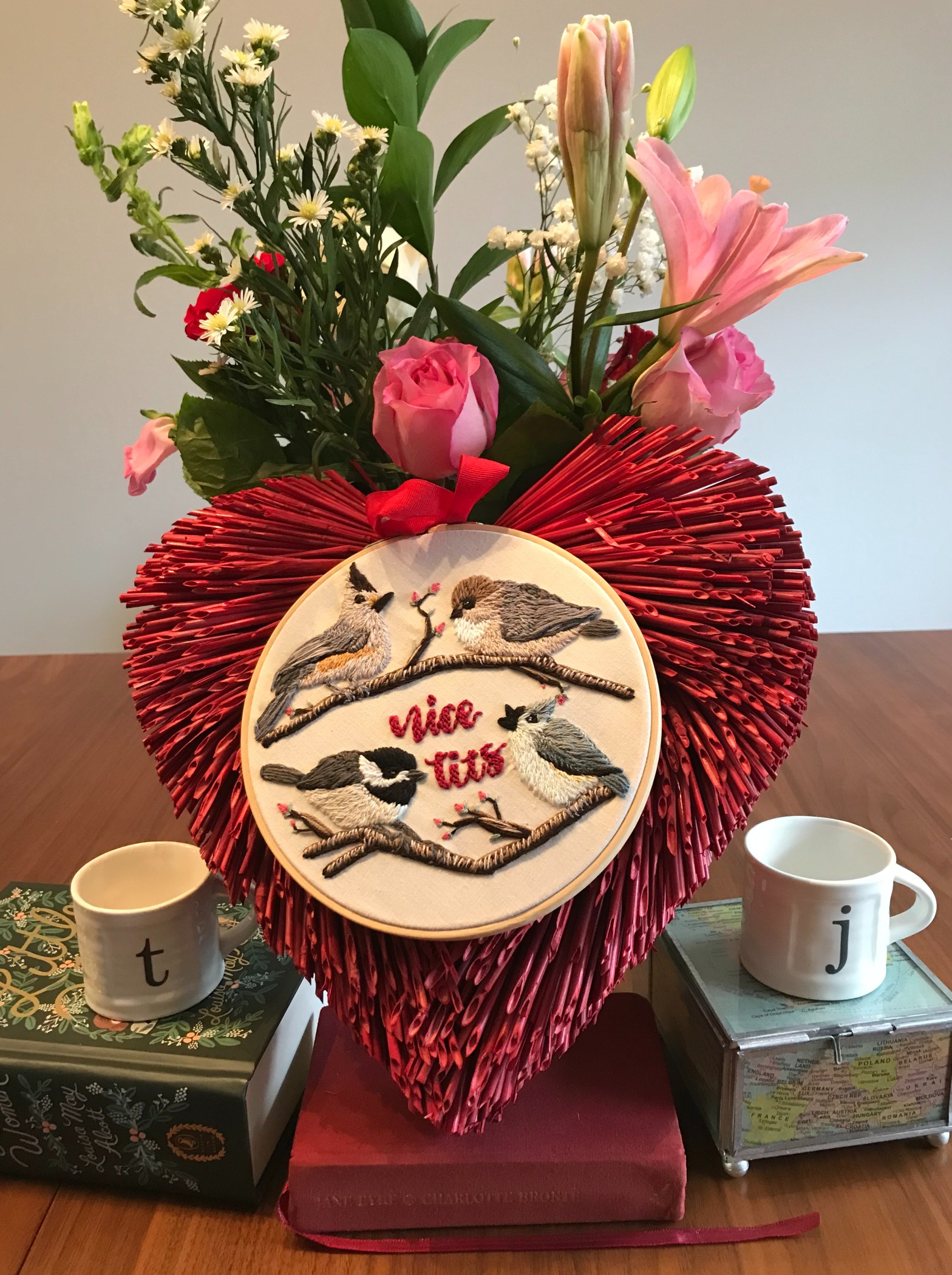
With sincerest apologies to Sara Bareilles and her hit 2007 single ‘Love Song,’ I lied and in fact will attempt to write an article on romance in stories. I realize I’m only one sentence in, but a quick aside- looks like my senior year of high school was a banner year for romantic classics such as ‘I Kissed a Girl,’ ‘Lollipop,’ and ‘Love in this Club.’ Tongue in cheek, but I can’t judge too much; I put together a prom-asking scavenger hunt for my then-girlfriend culminating in her finding me, with a bouquet of flowers and a borrowed guitar, attempting to play ‘Hey There Delilah’ by the Plain White T’s in the middle of the football field. But back to the topic at hand.
When I created this blog I jotted down a few ideas for articles in the somewhat vain hope I wouldn’t be scrambling for concepts. One of those ideas was something vaguely love/romance/ sex-in-stories themed to tie in to Valentine’s Day. Normally, despite procrastinating until the weekend to write, I have a few mental if not actual physical notes on subjects I want to cover. But I’ve been struggling to brainstorm this week. I think despite being someone who has deeply, deeply valued the love in his own life (romantic or otherwise), who (generally) looks back fondly at old flings and flames, and who is very open talking to friends about sex and relationships, I don’t particularly care to see it in stories. In my first post on fantasy I wrote that escapism is one of the primary reasons I love the genre. Maybe that’s the reason then I don’t chase these themes in stories. I spend a good deal of my non-story immersed time on these topics, so perhaps I want something else during story time itself.
I’m not remotely opposed to a romantic subplot or a bit of steam or smut in a story; just going through a mental catalog of my favorites and those are never the drivers. I don’t know that I’ve ever read a true romance novel. I tend to shy away from YA fantasy dominated by love triangles involving the heretofore textbook-average teenage girl who discovers she has powers and is suddenly slavishly pursued by the dark, lustful, so-bad-he’s-good immortal demigod and the boyishly handsome but was always out-of-my-league guy I grew up with. But I’ve never let lack of knowledge or involvement with a subject stop me from talking about it before so why start now. I’ll frame today’s post with a few tropes and use examples that I like (or don’t) in stories.
I watch it for the plot
There’s a YouTube video that made the rounds circa 2013 with a bunch of actors in LA excitedly telling their loved ones about landing new roles. Asked to expound they graphically describe their characters involvement in elaborate if not marginally (no judgment here) depraved sex scenes to growing expressions of horror on the faces of their friends/parents/spouses. Finally the commercial climaxes with those loved ones tearfully, angrily, or concernedly declaring the role is in a pornographic film, only for the actors to say ‘no no, it’s not porn, it’s HBO.’ The grief transforms to ebullient pride, joy, and celebration, we all have a sensible chuckle, end clip. I won’t directly link the video here as this is a family-friendly blog (side note: don’t let your children read this blog) but just give a Google to ‘It’s not porn, it’s HBO’ if you’re curious.
Look. I said I’m not opposed to smut in stories and I absolutely stand by that. I just want us to be honest about why these scenes are here. I’m not talking about true honest-to-god erotica (where graphic depictions are the whole point). But by and large stories carry these scenes because they’re fun. It was not essential that our leads have a plot-important conversation in Game of Thrones while being served by topless women in a brothel. If you hold The Dresden Files, A Court of Thorns and Roses, or The Demon Cycle series up to your ear, you can hear the authors heavily mouth-breathing as they write. I’m currently on book nine of 14 in The Wheel of Time– a series Google tells me has almost 4.5 million words. I wonder how many of those words are ‘breast,’ ‘bosom,’ or ‘cleavage.’ Female character’s armor in videogames is famously parodied, we’re not going to throw Henry Cavill or Jason Momoa onscreen unless we get them shirtless. Even when sexual awakening is part of the narrative (Bridgerton), we’re doing a sex montage not so much to reinforce the point but because we could all use a few more butts in our lives. This is lovely and fun and I enjoy it as much as the next person. Let’s just not pretend it’s anything deeper.
When the sun has set, no candle can ever replace it
The massacre of Loras Tyrell’s character, who spoke the above quote about the death of his love in the books (but is reduced to a gay stereotype in the show) ranks highly to me amongst the worst crimes committed by the Game of Thrones showrunners. But I don’t want to get too sidetracked. There are a phenomenal number of stories where loss inspires a ripple effect leading to revolution. Eo in Red Rising. Rue in The Hunger Games. Lyanna Stark. Juliette Mao. Lily Potter. Other stories where the antihero’s motivation to dismantle an organization is revealed near the end of a story. Spoilers here, but The Boys, Six of Crows, Lucky Number Slevin.
Those plot devices aside- I’ll always have a soft spot for breakup/heartache stories and the ways they fundamentally shatter a character. In the Gentlemen Bastard Sequence, Locke Lamora, the legendary Thorn of Camorr, mastermind willing to challenge the entire criminal, political, and magical world orders in this late-Renaissance era Venetian-inspired fantasy world, is reduced to a quivering mass of emptiness depending on the state of his relationship with Sabetha. In the still-to-be-resolved Kingkiller Chronicle, Kvothe, a legendary warrior bard and arcanist, is reduced to a a pseudo-anonymous rural innkeeper, seemingly with the barest fraction of his old powers. If we take his accounts at face value (and I know there is debate about his reliability as a narrator), something broke him of his powers. And I’ve always assumed, though we’ll need to wait for the indefinitely delayed final book in the series to know for sure, that something is to do with Denna, the woman who flits in and out of his life long enough break his heart each time.
Amor vincit omnia
Although based on a quote by Virgil, my first exposure to this phrase in stories was presumably in ‘The Prioress’s Tale’ from Chaucer’s The Canterbury Tales. In this context, the love here is supposed to be the love of god. Given both my general thoughts on religion, and that the Prioress’s Tale is one of many examples in Medieval Christianity of antisemitic stories about child martyrs killed by Jews, we’re starting on a bad foot. And honestly, it doesn’t get much better. I generally despise this trope in storytelling when it’s driven by romantic (especially teenage) love. I wrote in a previous post about my dislike of Leigh Bardugo’s Shadow and Bone trilogy, but the application of this idea is one of the primary reasons why I struggle so heavily with romance-driven YA fantasy stories in general. I have an impossibly hard time with the idea that the love between a couple of 17-year-olds is somehow deeply magic enough to stave off the stories’ apocalypses. I don’t mean to put down those relationships. Your first love in life can drive you to both positive and negative emotional extremes that are rarely rivaled by anything thereafter. But to me first relationships are building points in your life, essential to learning who you are but not the be-all and end-all of your existence. The first love can grow to a permanence, but I can’t get behind the idea that, in its infancy, it’s at that ‘conquers all’ stage. I’m still in touch with some of my earliest romantic interests, and they are by and large wonderful people and I’m grateful for their presence in my life. But those relationships changed over time.
I will immediately contrast this with platonic love, and possibly out myself as a hypocrite in the process. My strongest friendships, most of which I made during high school, some earlier, are among the most powerful relationships I have. These loves haven’t so much changed as they have grown. Wield a platonic love as a powerful instrument in a story and I’m absolutely onboard. I’d argue Harry Potter handled relationships well in general. Our characters had romantic interests which influenced, but did not dominate, their lives and stories. Each had the chance to learn and grow through other loves before finding a long-term partner. But more importantly to me it was the love between Harry’s friends that conquered all in the story. Much of the The Order of the Phoenix centers around the why behind Voldemort’s attempted murder of Harry and a prophecy that Harry will have a power the Dark Lord knows not, a power we learn is something as simple and deeply complicated as love. This power manifests throughout the series. Lily’s sacrifice-imbued protection her son. Snape’s obsessive love of Lily leading him to turn on Voldemort. But in this book, and in a scene I think the movies handled exceptionally well, Voldemort tries to possess Harry only to find he cannot. Not due to the since-nullified lingering protection of his mother, but rather Harry’s love for his friends who accompanied him on pure faith to the Ministry of Magic. It’s their faces and those bonds that defeat Voldemort in that moment.
How do you feel about romance in stories? Have a series that handles it well? Is it instead a guilty pleasure? Let me know.
 Twenty-five Hundred Stories
I’ve been worn weary by romance in books. Even though I’ll choose my preferred couple out of the triangle it just comes off as a cheap distraction. I recently read Ninth House and I was thrilled that there was not a primary focus on romance.
LikeLike