Since starting this (wildly intermittent) book blog over two-and-a-half-years ago I’ve developed much more sympathy for the recipe sites that give you a narrative in four-part harmony over several digital pages before diving into the recipe proper where I find out I forgot to buy half the ingredients and will have to wing it anyways. Also sympathy for run-on sentences. It’s just sometimes I have no desire to drive straight to the point. I do that at work. Put the bottom line up front, lay everything out into clauses, make sure deadlines and asks are easy to find and address. That sort of writing can be satisfying in its own right but here I’d rather take the Dickens approach and pretend I’m being paid by the word (which, good news, I’m not being paid at all. It’s actually the opposite. I pay WordPress to have this site).
So on the increasingly rare occasion I sit down here for a few hours to churn something out, I’m going to take my time. And next I open your recipe page and find your great-great-step aunt’s immigration journey laid out with pictures and thorough documentation, I appreciate you. I’m still clicking ‘jump to recipe’ BUT I appreciate you. Historically I keep my book reviews both spoiler-free and barebones so they fit into an Instagram post. I make the occasional exception and write it here if a series was long enough and involved enough of my time that there’s no way to otherwise do it justice. By and large though, I use this space to examine tropes and ideas and use what I’ve read as a way to frame those topics. I’m going to do a mix of both here.
I finished The Faithful and the Fallen (FatF) a month ago and had every intention of sitting down to write while the series was fresh. But in typical post becoming-a-parent fashion, that went by the wayside and here I am struggling to remember major events in the story, what I wanted to cover, and at times my own name and date of birth. So bear with me but with any luck we’ll make a little headway and you can hopefully share your own thoughts and we’ll get a nice dialogue and/or stew going.
Spoiler Free Synopsis
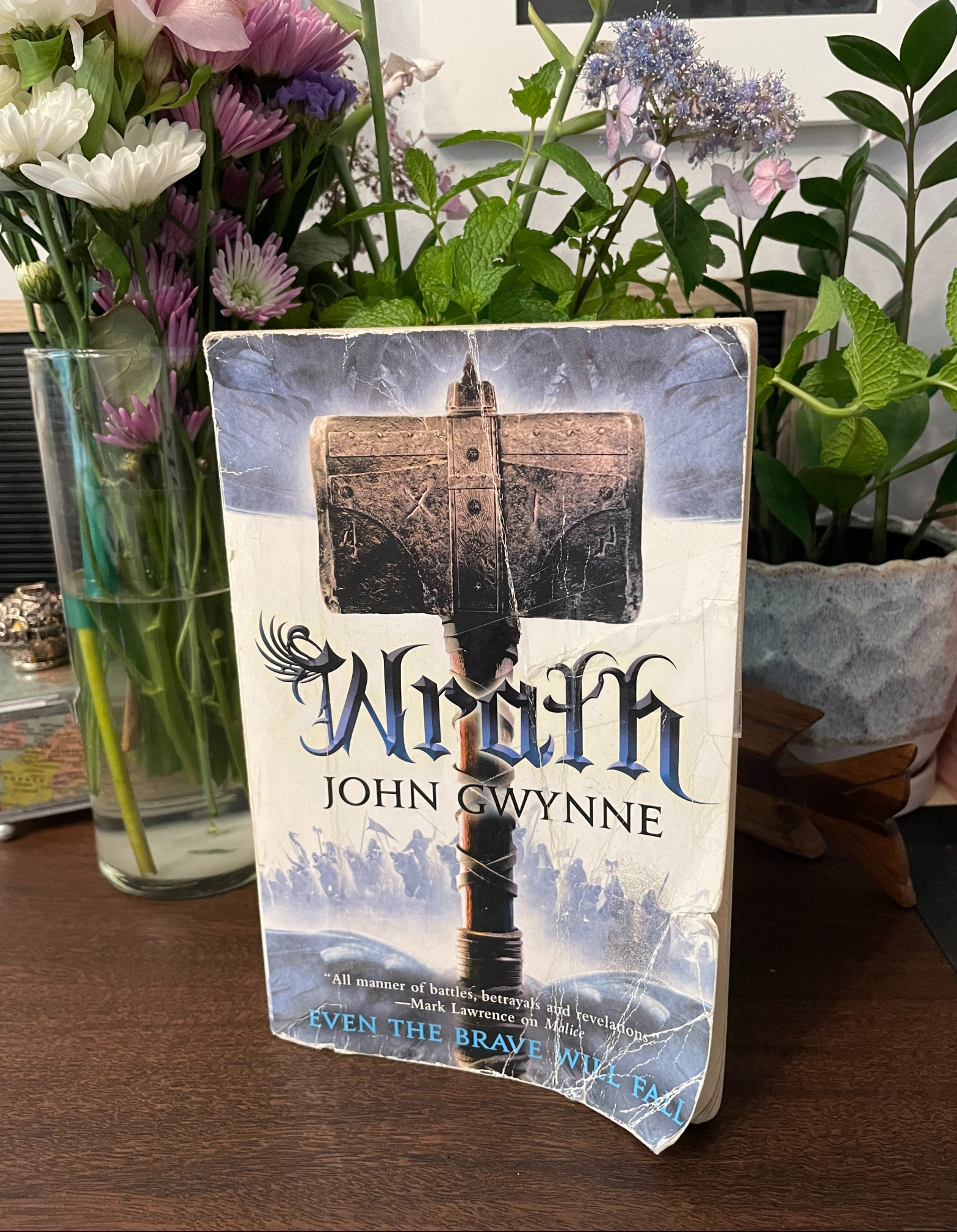
FatF represents the debut series for British author and Viking re-enactor John Gwynne (seriously run an image search on him, it makes me happy) and is composed of four books averaging a little over 700 pages a novel; Malice (2012), followed by Valor (2014), Ruin (2015), and Wrath (2016). The story is set on the Banished Lands; a continent with ten or so clans descended from settlers who first arrived some thousand years earlier as exiles under mysterious circumstances. As the story begins, the Banished Lands have been in a period of relative stability. The Giants who once held dominion have been pushed to the fringes. The clans, despite rivalries and skirmishes, mostly keep one another in check. The Scourging, the ancient battle where Elyion the creator emerged victorious over Asroth, the Lightbringer, has largely retreated into the realm of myth.
Elyion himself disappeared in grief and shame seeing the consequences of his last battle. Yet now there’s no question Asroth, recovered from his defeat, is moving once more in the world. The stones bleed and the wyrms are awakening and somewhere in the Banished Lands his champion, the Black Sun, is rising. The Banished Lands’ only hope may be if the Bright Star, Elyion the Absent’s chosen, can complete his training and consolidate support in time.
Spoilers Start Here
Ye be warned. Proceed at your own risk, etc. etc. I’m not going to sit here and summarize the series, but what I will do is run through some tropes or ideas that either tickled my fancy or rustled my jimmies or some combination thereof and discuss them with reckless disregard for major plot reveals. So let’s do just that.
Are We the Baddies?
One of, I think, the most positive trends in modern storytelling is the push to give the villains a recognizable motive. Often the formula is give the bad guy a reasonable premise, but then watch them push it too far. We see the hero defeat them, then do the same thing the villain wanted but without despair and major bloodshed (e.g. Black Panther). Other times we have a villain who has been pushed to the fringes and snaps and, while we wholly disagree with their actions (unless we’re in our preteen edge lord phase), we can at least understand they’re doing this because they’ve decided being crazy is the only option in a crazy world (the Joker in Dark Knight). But it’s a bit of a leap in some stories when the villain is just recklessly evil for no apparent reason. What did the White Walkers want in A Song of Ice and Fire? Are we really supposed to believe the Haradrim in The Lord of the Rings hate Gondor so much that they’re willing to fight side-by-side with orcs (total sidebar, I thought the ‘humanization’ [weird word here, given the circumstances] of the orc’s motives was one of the stronger parts of the Rings of Power season one).
The obviously evil armies in so many fantasy stories are taken for granted. Except in FotF Gwynne gave one of my favorite solutions to this problem. A prophecy covered early in the series references the two avatars of the warring gods, the Bright Star and the Black Sun. Nathair, the son of the reigning high king is frustrated by his father’s constrained thinking and knows the Banished Lands could be a better place. Enter Caladis, a mysterious advisor who, revealing himself to be one of the Ben-Elim, angelic beings in service to Elyion, tells Nathair of his destiny as the Bright Star. With Caladis in his ear, Nathair fights to unite the clans in preparation for the coming God War. Except- Caladis isn’t a Ben-Elim. Instead he leads the Kadoshim, demonic servants of Asroth. By guiding, coaxing, and manipulating Nathair, Calidus has done the work of Asroth with Nathair being none-the-wiser. By the time Nathair discovers the truth, that he himself is not the Bright Star but rather the Black Sun, he’s in way too deep and must continue on his current path to try and justify the atrocities he’s since committed. With this neat little bow, we don’t need a whole army of evil. Instead we just have Calidus and a handful of well-placed other leaders who can pull the strings.
I can’t be a wizard. I mean, I’m just Harry
I know it’s cliché, but I’m all about the unassuming country/farming/woodland teenager who’s secretly destined to save the day. With apologies to Katniss, Feyre, and Darrow et al., I’m a particular fan of the previous generation knowing our hero is important but withholding that information until the lead comes of age. Harry Potter and Rand from Wheel of Time both fit the bill, as does Jon Snow. And now in FatF we meet Corban. At right around fourteen when our story begins, Corban freezes when confronted by the neighborhood bully, Rafe. Yet as the first book wears on, Corban finds his courage. Off for some brooding time alone in the woods, Corban rescues a pregnant wolven (basically a direwolf) and kicks off a chain of events where he has one of the cubs as a companion of his own. He learns the sword from Gar, a foreigner and resident stablemaster who has always been close with Corban’s family. On a dare he raids the house of Brina, the classic gruff old lady with a gooey center, and learns his herblore. Bit-by-bit he grows both in stature and confidence until a fateful night when Nathair, visiting Corban’s clan, allows a coup against Corban’s king to put his handpicked successor in place and, in the battle, kills Corban’s father.
Now on the run with a small group of survivors, Corban learns the truth from Gar and his mother- he is the Bright Star of legend (more on this later). It’s his destiny to gather support and defeat the Black Sun and Asroth, despite Elyion’s continued absence. Of course now all of Corban’s special training makes sense. Yet the delay in telling him his destiny means his loyalties are now conflicted; his friends, his sister, his kingdom, while Gar and his mother urge him to take the wider view.
Ugh One of These Chapters
With the rise of Game of Thrones I feel the many-POV book where each chapter has the name of the POV character is all the rage. I don’t mind in theory. The POV switches give you two opportunities as an author: 1) you can have a set of eyes in each geographic area of the story that you want to track. You don’t need to have characters mysteriously show up at the climax, instead you can track their progress and watch as they get closer and closer to meeting (of course, once the POVs meet, a character becomes redundant which is a GREAT opportunity to kill someone off). 2) you can compare and contrast someone’s external description of a character with their internal monologue. Is this person really as evil as they sound?
My main critique of this series (Other than the shear number of beheadings. Seriously – If I had a nickel for each time I read the phrase “head spinning through the air,” I would have an unwieldy number of nickels) was unnecessary POVs. Our two mains, Corban and Nathair, almost always progressed the story. And I just genuinely liked Cwyen, Corban’s sister, Veradis, Nathair’s best friend and first sword, and Camlin, loveable woodsman. But so many characters I finished the story with without really understanding why we needed to see them. Maquin (AKA Maximus from Gladiator. Literally identical), Fidele, Uthas. As the books wore on we kept having new POVs and I never quite trusted that we’d need them. Given the stakes of the story I didn’t see the point in some of the lower scale conflicts.
My two least favorite, by far and in order, were Lykos and Rafe. Lykos I couldn’t decide how Gwynne wanted me to feel. He’s basically knockoff evil Jack Sparrow. I couldn’t tell if I was supposed to hate-like him or like to hate him. He lazed about and drank but somehow went toe-to-toe with some of the story’s uberwarriors. He rebelled against authority but still took orders, he was obsessed with Fidele to the distraction of his other goals. Yet despite my irritation with Lykos he was nothing to Rafe. Look. I understand the satisfaction of beating the childhood bully. But Rafe just kept coming back to no real effect and in the end it wasn’t even Corban who had the direct conflict- it was Camlin. And Camlin already had the battle against his personal boogeyman. So I kept hating the Rafe chapters, waiting for the payoff, and it just never came.
The Self Fulfilling Prophecy
Major spoilers in this section. I’ve written previously on how to successfully navigate prophecy in storytelling. I always come back to the scene in The Matrix where Neo meets the Oracle and she warns him not to worry about the vase. Spinning around to see what she’s talking about, Neo then knocks over the vase and the Oracle comments that what’s really going to stick with him later was would Neo still have broken it had she not said anything. FatF directly tackles this problem. For three and a half books we see Corban and Nathair desperately wrestling with their places in the prophecy. Calidus has been trying to position the world to be ready for Asroth and his opposite with the Ben-Elim, Meicel, presumably does the same on the side of Elyion. Except- there is no Bright Star. There is no Black Sun. The Ben-Elim and Meical manufactured the prophecy generations ago as a gambit to lure the followers of Asroth and powerful relics into one place in an attempt to destroy them once and for all.
Corban wrestles with this reveal. His followers and friends have been fighting and dying for something he now views as a lie. The strongest part of this series however are the relationships between the characters and the love between the companions leading Corban’s growing army. His friends, and his army, don’t fight for Corban because he’s the Bright Star. They fight for Corban because he’s Corban, and because he fights for them. I like the reveal because it keeps the value on the character’s own actions and decisions and does not punt them to some divine destiny. But perhaps more intriguing is the little bit of wiggle room. Meical comments that the prophecy has evolved somewhat since he first penned it. He initially just chalks it up to how words and stories tend to evolve on their own over time, no matter what you do. Yet there are a couple portions of the prophecy that apply to Corban that Meical could never have known, including the names he gave his wolven and his stallion. I expected Elyion to return during the final confrontation. In fact I assumed the whole series was a set up for just that. But I was wrong. Yet, given those sticking points in the prophecy maybe Elyion is starting to stir after all.
Have your own thoughts on the series? Let me know!
 Twenty-five Hundred Stories
One thought on “The Faithful and the Fallen”