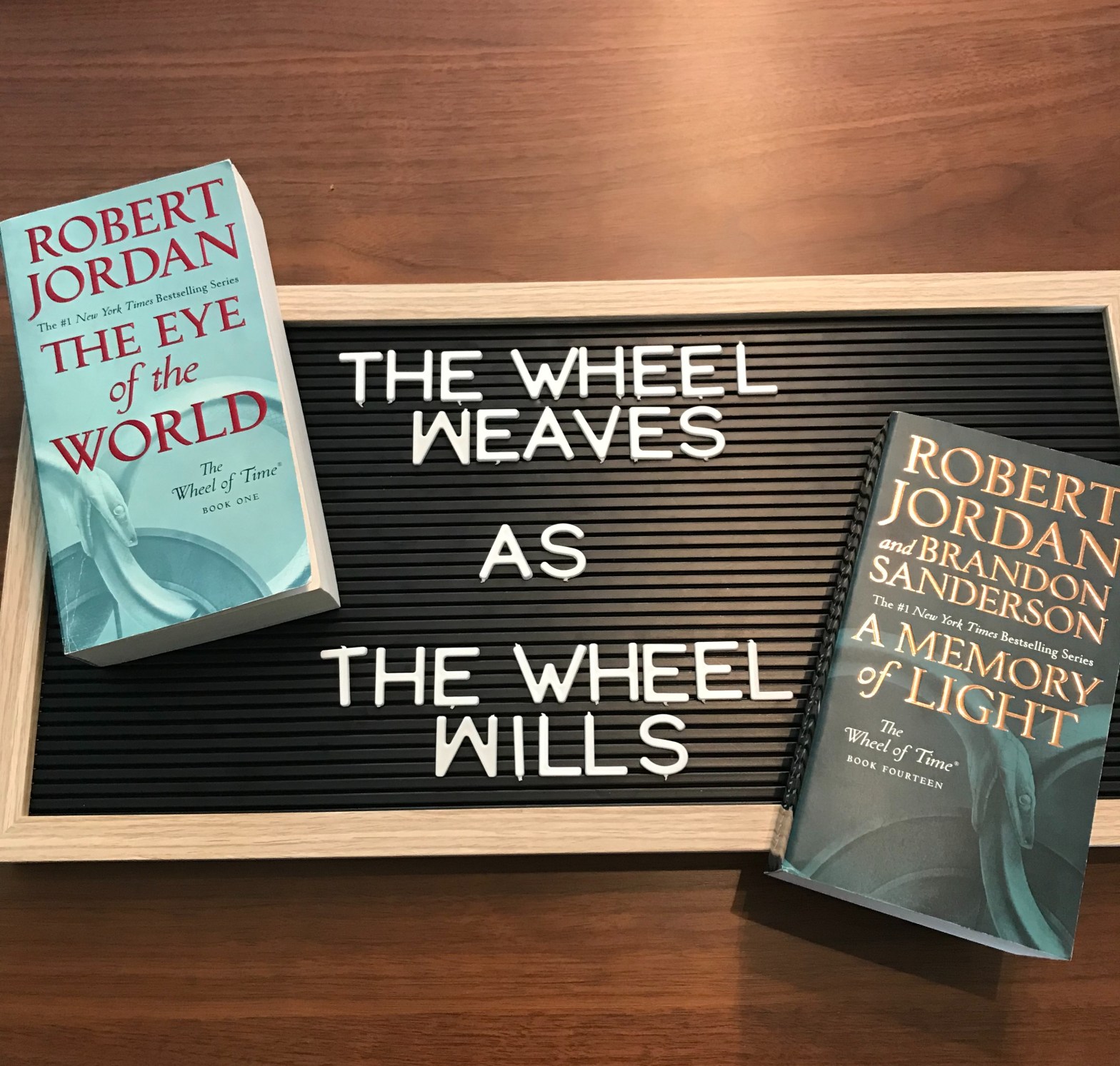
The Wheel of Time turns, and Ages come and pass, leaving memories that become legend. Legend fades to myth, and even myth is long forgotten when the Age that gave it birth comes again. In one Age, called [February 2020] by some, an Age yet to come, an Age long past, a friend sat next to me in the back of a rented party bus and finally made me swear to try out Robert Jordan’s FOURTEEN BOOK series known as The Wheel of Time under pain of excommunication from the friend group. WoT hovered on the periphery of my awareness for years; I’d seen copies on bookshelves, garish covers an art style somewhere between bodice-ripper romance and the 1963 cartoon Merlin movie The Sword in the Stone. Writers made comparisons with other fantasy series and it came up as I grew both more familiar with and fond of Brandon Sanderson’s other works (Sanderson wrote the final three books of WoT following Jordan’s death).
Yet despite the seemingly glaring hole in my fantasy bibliography I never had much interest in diving into the series. It was less a reflection of the series itself (I knew nothing about it) and more hesitation on the sheer time commitment involved. But that February years of hedging came to a head at the culmination of what is affectionately known as Birthday Month in my group given the proportionately incredible number of my friends born in the shortest month of the year (though, I might add, not I). Celebrations compounded and, if they ever ended, seemed to repeat. And so perhaps it was that floating month-long non-drivable blood alcohol content coupled with threats that made me finally agree. A few weeks later I bought the first book (The Eye of the World), sent my friend a picture of the purchase to stave her off for the moment, and put the novel in my to-be-read pile. And then a funny thing happened.
News reports started escalating in the US about a virus that had up until that point felt fairly remote. I left a D&D session with friends feeling uneasy about a series of minor shutdowns and decided to stop by a grocery store, eerily quiet but disconcertingly full for 10PM on a Tuesday. College conference basketball tournaments canceled one after the other. My office sent us home that Thursday saying we were doing a company-wide work-from-home day that Friday to test our infrastructure. Except we didn’t go back. And that was 480 days ago from the time I wrote this article. Birthday month bled into a March that morphed into what would become the most emotionally extreme year-plus of my life.
The surrealism of the upending of daily routine faded into isolation from friends, the absence of rituals, and the terror that seeing loved ones might in a complete absence of hyperbole place them in mortal peril. Moments of joy fought a seemingly losing battle against that dementor-esque miasma. Zoom calls with friends I’d never see even pre-pandemic punctuated by hearing of losses in their families. The hopes of my wife and I trying to start a family punctured by two terrible setbacks made all the worse as she had to face the news alone with me waiting in the parking lot, unable to join her at the doctor. We bought our first home together in the fall but had to wait through one of the coldest, darkest winters I’ve faced to share it with friends.
For all the loss, fear, and exhaustion of the last year I did gain something for which I (and I’m sure everyone) have always longed: time. Gone were all my commitments, mandatory and otherwise. No more daily hour and a half spent commuting. No Monday night pub trivia, no floor hockey league, no movie theaters, baseball games, or restaurants. I cooked more, the apartment was neater despite the 24/7 occupation. We finally watched shows we’d had on a Netflix list for years. I started this blog midwinter (a replacement for the time I was spending outdoors). And of course, I read. A fourteen book series felt less daunting because in the most literal sense I had nothing else going on.
And so I picked up The Eye of the World paperback, the old fashioned way, before downloading the next thirteen books one after the other on Audible. I listened doing chores around the house, or the long runs and stationary bike rides I used to replace my time in the gym. I had books going as I made dinner or took walks or generally puttered around my bubble. The over four million words and roughly 675 chapters ran together to the point where I could not tell you which events happened in what book (or even without looking it up, the names of about half the books themselves). I consumed WoT (a series published between 1990 and 2013) as if it were one continuous story that was a near constant presence in my life during the first fifteen months of the pandemic.
When I began this blog I decided not to do direct reviews of books; I have a separate Instagram account where I will occasionally do so. Instead I want to focus on an analysis of stories and storytelling itself. I’m going to try and mostly keep to that rule now (though, as I attempted to rationalize this to myself, I decided I had every right to grant an exception given the sheer size of the time I spent with this series). So rather than do a blow-by-blow of each book or give my overall thoughts I’d rather pull out bits and pieces that left me particularly enthralled or aggrieved and take it from there.
My plan for this post, context on my reading experience, and spoiler philosophy
First- generally speaking I try to make these posts accessible to those who may not have read the stories. I’m not above using an esoteric reference in the hopes of evoking a laugh, or at least a short exhalation of air from the nostrils, from a smaller subset of any particular fandom. But by and large I keep to concepts and stay out of the weeds. I’m going to try and do the same in this article but I suspect I may door a poor job. This will after all be the first time I’ve focused exclusively on one story and as such, and like any good compromise, hopefully everyone leaves disappointed. The casual passers-through not knowing what we’re talking about and being vaguely unsettled by the phrase ‘a kiss and a cuddle.’ The hardcore WoTers irritated I didn’t do a critical analysis of Domani fashion as an allegory for prerevolutionary Iran and how it pertains to third-wave feminism. But let’s see how it plays out.
Second- a reminder that I read (listened) to these books one after the other. If you’re going to try and get me to remember what happened in a specific book, you’re going to have a bad time. A lot of the characters run together for me, and I expect I’ll have to do a reread some day to really pick up on some of the nuance. Given that I listened to the series I don’t know how to spell anything. Odds are if I included it in this post, I had to look it up. And third- my spoiler philosophy. I don’t intend to outright describe key events and outcomes per se but I’m also not going shy away from talking about relationships, overarching plot points, or particularly cool bits of magic that popped up in later books. I’ll probably skip a few items I’d otherwise like to talk about just because I don’t want to give everything away. But if you’re one of those people who want to walk into a story with a blank slate, close out now or forever hold your peace.
A BRIEF synopsis to set the stage
Fourteen book series (I know, I know, there’s a prequel. I’ll do it someday). So I’m not recapping the whole thing. But just a quick back of the book blurb to understand vaguely what’s going as we head into the next few sections. Time, by nature of the Wheel, is cyclical. Ages come and go, with no true beginnings and no true endings, but names and lives repeating themselves in the Pattern of the world. Throughout history the forces of light and shadow have fought to shift the balance of power. Thousands of years ago during the Second Age, or the Age of Legends as it’s now known, certain men and women worked together channeling halves of the source of magic called the One Power to weave wonders and thwart the Dark One, Shai’tan. The Age of Legends ended with a desperate gambit by the most powerful channeler, Lews Therin Telamon (known as the Dragon), who, faced with the defection of many of his companions to the Shadow, tried to seal away the Dark One. Although mostly a success, the Dark One managed a counterattack in which the male half of the source, Saidin, was tainted, causing all those who channel it to go mad. Lews Therin, in the throes of this madness, broke the world and ended the Second Age.
Today the wonders of the Age of Legends have long since faded into myth. Channeling is restricted to women and tightly controlled by an organization known as the Aes Sedai, a group both independent from and above kingdoms and separated into seven different Ajahs. Men who can channel are gentled, stripped of their ability to touch the One Power (and of their will to live), to avoid the lingering madness of the taint. In the last few years however signs and portents indicate the coming of the Last Battle, a final confrontation between Shai’tan and Lews Therin reincarnated, the Dragon Reborn, where victory for the Dark One would result in the destruction of the Wheel. Shadow creatures once more roam the land, the seals keeping the Dark One locked away are weakening, and the Shadow’s most dedicated servants, the Forsaken, grab the reins of power. A single Aes Sedai and her Warder come to a small village in a region called The Two Rivers and find three boys with the innate ability to shape the Pattern around them. One of them, Rand Al’Thor, may just be something more. Can Rand fulfill the prophecies and make it to the Last Battle or will madness take him first? Will any of the world’s factions, vying for their own power, claim him as their own? Will his distrust and rage at being used lead to a second breaking? Tune in next time on Dragon Ball Z.
Wheel of Time Magic Systems
As mentioned, the primary magic system in WoT is called channeling. Only a small subset of people can channel and the ability appears to be innate. One channels the female half, Saidar, by learning to submit to the One Power while the male half, Saidin, must be seized. Sexist gender norm assumptions aside, each half works through the weaving of the elements. Men can’t see weaves of Saidar (and vice versa), but usually a channeler of your type can replicate your weave if they see you perform it (given they are of sufficient innate power). By and large I’m not a huge fan of channeling as it was portrayed in the first half a dozen or so books of the series. I don’t love innate magical strength in stories (or, at the very least, I want strength to be surpassable through cleverness, compassion, diligence, etc.). My primary critique is strength in the power served solely as a plot device. Use of the One Power was not particularly creative- the stronger character in a head-to-head contest was simply the who needed for plot purposes. If we needed to cheat, we introduced artifacts called Angreal and Sa’Angreal (which enabled the user to channel more of the power).
From a story-telling perspective I prefer magic where there’s more of an obvious pay-off correlated to the work our characters put in (verses something with which they were born). Although we do see more creative applications of channeling in later books (where the system definitely grew on me) I much preferred the series’ peripheral magic. Especially that tied more to shared emotion. As I mentioned earlier channelers have the ability to bond Warders, guardians who, through the use of this magic, share thoughts and impressions with their channelers. The nature of these bonds are heavily explored in the second half of the series and do a wonderful job of describing relationships going beyond some of the cliched romance and sexuality you sometimes see in fantasy stories. Other examples of relationship-based magic: First Sisters amongst the Aiel people and the obviously horrific but wonderfully complex channeling between Sul’dam slavers and Domane slaves in the Seanchan.
On Relationships
WoT’s strength (at least in the Jordan-authored books) lies more in the strength of friendships, mentor-student bonds, Warders, etc. than it does in romantic relationships. I’ve noticed a trend in fantasy stories where authors really, really want to have their characters in romantic relationships (and are willing to develop those romantic relationships once they exist) but don’t want to actually spend the time and effort establishing those relationships in the first place. I genuinely enjoy Nyneave and Lan as a couple but the extent of their on-page courtship appears to be she managed to sneak up on him once and he was into it. Rand and his harem- there’s a little bit of build, but by and large it’s waived away via the concept of Ta’Veren (more on that in a bit). Perrin and Faile? Christ. Look. Jordan definitely spent time on this relationship. But barring a few shining examples in the Sanderson books it was absolutely painful. I don’t know if it was just a miscalculation thinking that we the readers would care more about them. But I was down at the beach with friends in late May and we sat there in a room and made a bracket of the 64 worst things about WoT, March Madness style and put them head-to-head round-after-round. About half of the shortlist were Perrin/Faile related (with a little Gawyn/Egwene for good measure). Mat’s pursuits fell more into the one-night-stand category (or, as the series called it, a ‘kiss and a cuddle’) and were usually at least worth a laugh.
Ta’veren and Webs of Destiny
As mentioned earlier the Wheel of Time spins out something of a predetermined Pattern for each Age. If the Age’s events drift too far from the Pattern, the Wheel creates Ta’veren, individuals around whom the improbable (but not the impossible) occurs to correct the drift. Three of our main characters, Rand, Perrin, and Mat, are among the most powerful Ta’veren the world has seen in an Age. I want to be abundantly clear. The concept of a Ta’veren is absolutely a deus ex machina. And it may seem hypocritical for me to complain about relative strength in the One Power as a plot device in one paragraph and then praise a different clear plot device in another. But I’ll argue you can get away with it if you break the fourth wall. The characters are well aware of their nature- Rand deliberately leans on his Ta’veren status during negotiations. Mat, a chronic gambler and non-controversially everyone’s favorite character after a rough first few books, learns to manipulate his luck to any end. From a story standpoint- if our boys’ Ta’veren-ness were something that occasionally happened to them at plot-centric points it would bug me. Instead we see them try and wield these powers with mixed results.
The Rogues’ Gallery
I’m going to give mixed reviews on the villains. I’ll stay away from Shai’tan himself as I don’t know how I can discuss him without getting too specific into the outcomes of the Last Battle. Instead I’ll say often more interesting were the internal struggles for our characters. Lan with his sometimes conflicting duty to the Aes Sedai, his fallen kingdom Malkier, and to the Last Battle. Rand his anger at being used and the looming threat of his own madness. Aviendha’s dedication to the Aiel sense of honor, Ji’e’toh and its clash with the changing world. The Forsaken weren’t terrible characters (in the story-telling sense, obviously they left a lot to be desired in the humanitarian sense). Watching dialogue between them and their jockeying for power were satisfying scenes. But the Dark One’s ability to re-insert them into the Pattern if they were killed by anything but the most destructive of weaves somewhat lowered the stakes. An apt comparison is if Harry faced Voldemort at the end of each book while he was still sustained by horcruxes. Yes- the threat faced by Harry is very real. But defeating Voldemort would leave a little bit of lingering ‘so what.’ Altogether more interesting to me was the Black Ajah, a rumored 8th Ajah in the Aes Sedai composed of secret servants to the Dark One with their own legends, prophecies, and histories, and the knowledge that any of the characters might really be of the shadow.
Cultural References and Analogues
In the fine tradition of many fantasy stories WoT uses a sprawling map comprising many kingdoms and countries with real world similarities to present or historical cultures. The conflict between shadow and light and the balanced symbols for the Flame of Tar Valon and the Dragon’s Fang are a literal yin and yang (with the One Power a nod to Taoist metaphysical oneness where distinctions are only perception). Other references are made to Judeo-Christian belief systems with the conflict between the creator and destroyer. Different regions have their own languages, outfits, religious practices, and speech patterns, and prophecies concerning Rand and the Last Battle. It’s engaging and immersive and on the whole makes me deeply uneasy. There is a bit of a fetishization in fantasy stories in particular of Arab culture. I don’t know where it started. The Fremen from Dune, the Saracen-appearing Haradrim in the Lord of the Rings films, the Krasians in The Demon Cycle, the Aiel in Wheel of Time. I’m not saying WoT does anything poorly, but my issue is I can’t say for sure if it does it well. I simply do not know enough about the cultures depicted (or parodied) to say one way or the other. I’m wary any time I see western authors using Middle Eastern or Asian cultural references and philosophies. I just really hope they did their homework.
You can’t ignore its girth, plus the Sanderson takeover
This series was published over the course of 23 years. Those who followed along undoubtedly had a much different experience than mine, but I’m unable to give any opinion other than that of someone who read it continuously over the course of a single year. Sprawling stories are a challenge. We’ve seen wonderful series derailed as an author struggles to tie together all the threads (A Song of Ice and Fire the most relevant modern example). How do you take decades of work and and bring it home? I can look back over the last year of my life (admittedly about as non-traditional as they come) and reflect on how much my personal feelings and circumstances have changed. Imagine being an author and facing the emotional churn that comes over the course of two decades.
I don’t know how this story would have ended if not for the death of Robert Jordan but it’s certainly easier to be ruthless to a dead end plot point when it’s not your baby. Sanderson was far from unattached to this story- listening to his accounts, this series was one of the largest influences on him as a writer and receiving the call from Jordan’s wife about finishing the series (using Jordan’s extensive notes) was one of the more humbling moments in his professional career. But the sunk cost effect is easier to ignore when it’s someone else’s work. I mentioned earlier about the redundancy of the revivals of some of the Forsaken. I’ll include other ‘major’ plot points- Couladin as the rival Car’a’carn (and really the entire conflict with the Shaido Aiel). The prophet Masema. Faile’s kidnapping. Even characters we’re arguably attached to like Elayne and the whole Cairhienen succession have little to do with the overall story.
To bring it back to Harry Potter, one of Rowling’s wiser choices was dropping Quidditch or concerns like the House Cup in later books. We enjoyed them well enough, but they ceased to matter to the conflict as a whole. I’d argue there were at least 3-4 books of material that could reasonably have been cut from WoT without detriment to the plot. And I’d wager I’m not alone. The Gathering Storm, the 12th book in the series and the first by Sanderson, kills off a recurring (but pointless) character in the prologue and uses a line to the effect of ‘and we’ll never speak of this again.’ You cannot convince me that wasn’t intentionally tongue-in-cheek. The length of the story didn’t bother me like I thought it might (once again, I had a lot of time last year). And I only had a few moments where I was frustrated with the pace (I think I had the realization at the end of Crossroads of Twilight, the 10th book, that there was zero plot advancement during that novel). But I’m immensely curious how the upcoming Amazon Prime show will prune the story.
I very lightly covered a bunch of topics here. I know some of you will want to engage on specifics. Please, please grab me if you do, and for the rest of you we’ll return to our regularly scheduled content shortly!
 Twenty-five Hundred Stories
I’d never really thought about it until you pointed it out, but the One Power as a magic system does leave quite a bit to be desired. There is some lip service paid to the idea of “dexterity” and “skill” making up for sheer power, but for the most part sheer power is what matters and they pay a great deal of attention to it (one of the main exceptions is The Sea Folk and their skills with weather, maybe a case to be made for Egwene and her particular skill/inventiveness with earth). But there’s little to no answers to the question “how”? I think the One Power sees some significant systemic improvements when Sanderson comes into the picture, but I don’t think Androl alone really makes up for eleven books of most things being based on relative strength (and as Sonia has pointed out, if you’re going to be really good at just ONE thing, opening portals quickly and at will to and from anywhere is a pretty dope thing to be good at). Sanderson criticizes the obsession with relative power in several places and from several perspectives (Cadsuane, Nynaeve PoV, Aiel leadership structures, etc.), but again, it just doesn’t entirely make up for how long we’ve had to put up with it. You’re right to point out that the “relationship weaves” (binding, bonding, compulsion, first-sisters/first-brothers, visions of the past/future, etc.) are actually some of the more intriguing ones.
I think inventing a good magic system with defined rules that are followed is a really, really tough thing, and that it’s a rare fantasy author that’s both interested in setting up a system and good at it. The Stormlight oaths and the surges come to mind as one of the best I’ve ever encountered and that I’m genuinely excited to learn as much as possible about (though I don’t think I’ve ever seen deus ex machina moments entirely avoided in anything fantasy). I think the surges demonstrate that the way to set up magic systems well is finding a way to achieve 1.) balance (but with potential tiers) and 2.) diverse sets of abilities that 3. compliment and enhance character development. Conversely, we could talk for at least two hours about all the magical asymmetries, inconsistencies, and retcons in the Potterverse that don’t make too much sense without saying “because plot.” (I would argue that this is an aspect of the series that JKR did not find super interesting.)
I’ve never really thought of the Aiel “going into the desert as an existential punishment and getting really warlike” from the angle of cultural sampling that might not be that well researched, but like you, I don’t have the historical knowledge to make an argument one way or another. My first thought was more along the lines of the ancient Israelites (and obviously the Fremen). I enjoy the Aiel as a group of characters and as a main story arc the most, so I really hope that wasn’t done in a ham-handed way. Speaking of cultural references, Arthurian myth is obvious, but still deserves a mention. The Arthurian character names (Gawyn, Galad, Elayne, Nynaeve, Egwene, Morgase, Artur Hawkwing, and Moiraine) correlate to character roles in a pretty cool way, not to mention the idea of the king wielding a sacred blade drawn from a place literally named “The Stone” that came before and will come again. Hilariously, Gawyn is probably one of the more 1:1 characters, and this does nothing to make him more likable (Gawain in many iterations is actually better, but his main problem is an overinflated self-regard and consistently thwarting himself). You should add The Once and Future King to your reading list if you haven’t read it already.
I’m so glad you made the journey and I can’t wait to vigorously speculate and overanalyze when the show finally drops in December.! ❤
LikeLike