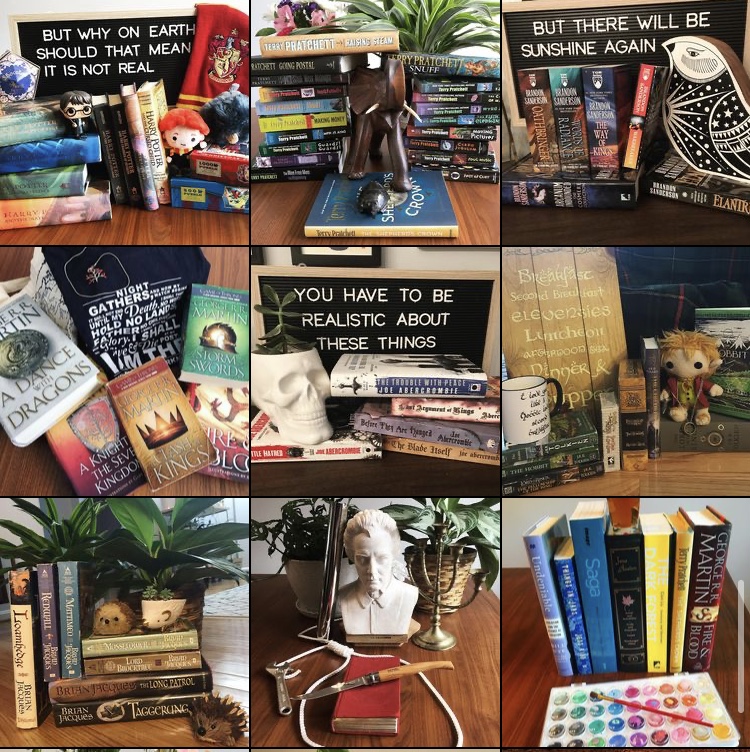
A bit of a different type of post this week. When I created Twenty-five Hundred Stories I broke the blog into two parts; this website (surprise) and an Instagram page. By and large I wanted to limit the former to longer discussions on stories/storytelling and the latter to shorter content like book reviews or picture challenges. Over the last week however I challenged myself to post my seven most impactful fantasy series on my IG page, giving a small blurb for each with an overview of the series and why each affected me. Individually none fit my criteria for this site, but in aggregate the posts give a pretty good snapshot into my love of fantasy stories. Given that- I decided to repost them all below. If you already saw them, by all means find other ways to occupy yourself but if you’re someone trying to avoid giving yet another Facebook owned app your information, please give them a read!
Writing for brevity has never been my strong suit. Like most quotes attributed to Mark Twain I’m assuming it’s apocryphal, but he supposedly said ‘I don’t have time to write you a short letter so I wrote you a long one.’ Given that I appreciated IG forcing me to keep each post under around 2,000 characters. And as a final reminder, these are my seven most impactful series, not necessarily my favorites. So without further ado:

Author: Brian Jacques
Today is day one of a self-imposed challenge to post seven fantasy series in seven days. I love all seven, but they don’t have to be the best I’ve read. They instead are those that had an outsized impact on my life. I’ll give a quick overview and share why they mattered to me. Starting, fittingly, with Redwall.
Published between 1986 and Jacques’ death in 2011, Redwall chronicles the stories of the anthropomorphic British woodland animals living in the eponymous Redwall Abbey and surrounding Mossflower Woods. The stories (geared toward older children) are Tolkien-esque in their strict depictions of good versus evil. Peaceful mice, hedgehogs, and moles must find courage to defend their homes against invading rats, stoats, and weasels. Our heroes find friends in the fierce but loyal hares in service of the badger lords of the volcano Salamandastron, the archer squirrels of the woods, or the nautically accented sling-wielding otters. With a widely spaced, back-and-forth chronology, almost every book features new characters, and heroes of myth in some stories feature as the leads in others.
Growing up my brother and I spent a good chunk of our summers biking through back neighborhoods down to the local library. After refueling with an illicit 25-cent Safeway-brand coke from a vending machine across the street (we weren’t allowed soda at home), we’d post up for the afternoon reading. My first stop was always to the ‘Js’ in children’s fantasy to see if there was a new installment of Redwall in stock. These weren’t the first books I read, but they were the first in which I fully immersed and couldn’t wait to get in my hands. Jacques introduced me to iconic elements of fantasy stories. The riddles and songs, the legendary weapons, the entirely-too-long graphic depictions of food and feasts. The character reluctantly forced to take up the hero’s mantle, the sage old teacher, the noble sacrifice. My love of fantasy started those summer afternoons with a Redwall book in the corner of the library.
Author: J.R.R. Tolkien
For day two of my challenge to post my seven most impactful fantasy series in seven days, I’ll throw it back to Tolkien.
John Ronald Reuel Tolkien took his love of European mythology and began his own in his teens. Invented languages and nomenclature, these writings (later the Legendarium) became a cosmology gathered by his son and published posthumously. The Legendarium also became the background for The Hobbit (1937) and its sequel, The Lord of the Rings (published in three volumes between 1954 and 1955). Those latter two works, in an “ancient time between the age of Faerie and the dominion of men,” were set in a world whose Third Age culminated in a final struggle between good and evil. On the one side, an uneasy alliance between the waxing power of the elves, the stubbornness of dwarves, and the pride of men. On the other: goblins and orcs and the ever-present eye of the dark lord, Sauron. Through this struggle, hobbits, a people often overlooked (and they like it this way!), find themselves as the very knife’s edge on which rests the fate of their world.
Unlike the other series in this challenge, my first exposure came through film. The Fellowship of the Ring, released right as I turned 12, started a trilogy which to this day remains my favorite adaptation of a story. I read and re-read the novels in advance of the next few films. Wonderfully cast, beautifully filmed, and exquisitely scored, I’ve watched these movies I don’t know how many times with friends quoting every line, else with my wife on rainy weekend afternoons. My groomsmen and I walked down the aisle at my wedding to the song “Concerning Hobbits.” Tolkien is the father of modern fantasy, and every single other story I’ve loved pays homage in some respect. From the first “in a hole in the ground there lived a hobbit” to the final “well, I’m back,” this series had an indescribable impact on a genre I love.

Author: Joe Abercrombie
Day three of my challenge to post my seven most impactful fantasy series and our first foray into grimdark with the Circle of the World.
A trilogy, three standalone novels, and a second trilogy, the series’ world is so dominated by warfare and rivalries that belief in magic seems long forgotten. At the geographic (if not metaphorical) center sits the Union, a realm ruled in name by the High King and in practice by the Closed Council (or perhaps the ever-watchful eyes and ears of the Inquisition). To the north, warrior clans who would be a power if only they could unite. In the south, the Gurkish Empire, a fanatical kingdom and looming threat. The first trilogy sees the end of the middle ages. The second, the beginnings of the industrial revolution. In both: life is nasty, brutish, and short. The poor doomed by their station, the rich by their ambition, and all the above pawns for another, unafraid to break the First Law and touch the Other Side.
Abercrombie’s writing alone is enough to propel this series into my list of favorites. He’s eminently aware of the tricks of his trade. He’ll weave a scene making you think you’re one point of view only to find it’s another. He’ll use identical chapter titles to show parallel events. He makes you intimately aware you’re reading a story while never quite breaching that fourth wall. Yet- it wasn’t his writing that made this series one of my seven but rather the way in which I first experienced it. I’d listened to books on CD, but The Blade Itself was my first title on Audible. Narrated by Steven Pacey, I fell in love with the format. I found myself seeking out other stories by narrators whose performances I so enjoyed. I made my only mod to my then-car for a stereo I could wire to my phone. Audiobooks gave me stories while commuting, working out, doing chores. I love the feel of a book but, per the title of my blog, we get only so many stories in a lifetime. This series taught me a way to enjoy more before I, as we all must, go back to the mud.
Author: George R.R. Martin
On to day four of my seven most impactful fantasy series!
George R.R. Martin’s sprawling epic is set on Westeros, a continent protected to the north by a towering sheet of ice known as The Wall and ruled for 300 years by the Targaryen family, dragon-riding conquerors from the east. Now, with the dragons long gone and the dynasty overthrown, Westeros’ powerful houses are engaged in a War of the Roses-esque struggle for the rule of the Seven Kingdoms. The conflict leaves them blind to the rise of a Targaryen heir and deaf to whispers, long dismissed as fairy tales, of a growing threat beyond The Wall. Martin’s story, through shifting points of view, lays bare the price of conflicting loyalties and the cost of mercy. After all, when you play the game of thrones: you win, or you die.
First published in 1996, ASOIAF exploded when the HBO series premiered in 2011 after the release of the fifth book. My exposure came a year later when I borrowed the first book during a post-grad trip in Europe. I tore through the series and caught up on the show. Sunday watch parties became routine with us book readers eagerly awaiting horrified reactions of our show-only friends. I spent hours recapping with colleagues, trading fan theories on Reddit, and eagerly checking updates on the release of the 6th book in the series. Except- that book never came. Confidence turned to unease and then panic as the show approached and surpassed the events of the book. I sat a horrified witness to the unwinding of a decade of character development and the transformation of consequences into cartoonish villains. Two years after the finale and ten years since a Dance with Dragons, I’ve mentally purged a series that once dominated my fandom. I could once recite every town, character, and castle across Westeros, but now, to quote Robert, ‘you want to know the horrible truth? I can’t even remember what she looked like.’
Author: Brandon Sanderson
Day five of my seven most impactful fantasy series brings us to the Cosmere, my most recent read on this list.
BrandoSando (as he’s affectionally known to my friend group and potentially no one else) is a machine, publishing at least 25 full length novels and dozens of other works since his debut in 2005. Already a name in fantasy circles, Sanderson achieved prominence with his conclusion of the Wheel of Time series following Robert Jordan’s death. Best known among Sanderson’s IP are his stories set in the Cosmere, a universe whose magic derives from the Shards of power left from an event known as the Shattering. The now-deities who seized the Shards settled on different worlds, the inhabitants of which may manifest powers unique to each Shard. Through this system Sanderson paved the way for readers to enjoy a sequence of stories set on the same planet while weaving hints to other worlds, creating a ‘hidden epic’ without the daunting feel of a 25-40 book series.
Sanderson’s productivity and willingness to interact with fans make him a crowd favorite, but the Cosmere made my list for the grace with which he portrays his characters. I won’t say there aren’t surprises in the Cosmere (there are). But its strength is journey before destination. With his focus on flashbacks and emotional introspection, I don’t know any other writer whose characters act so consistently with their motivations. They learn, they evolve, they regress. But I can’t remember an instance in the Cosmere where I didn’t understand someone’s actions. Sanderson also portrays people struggling with mental health as, well, people instead of a metaphor for larger events or mysterious source of power. It doesn’t make them less of a leader or a friend or a hero. The Cosmere shows the raw darkness of this struggle while reminding us that though not every day will be sunshine, there will be sunshine again. And that is a very different thing to say.
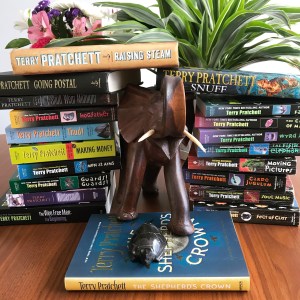
Author: Sir Terry Pratchett
Day six of my challenge yields the masterclass in satire that is the Discworld, held aloft by four giant elephants themselves riding the back of a galactic turtle.
The Discworld’s physicists, in addition to forces like gravity and electromagnetism, study its standing magical field and narrative causality (the principle that nothing exists without a Story to mold its destiny). Varied in its climate and geography, politics center on Ankh-Morpokh, a metropolitan hub with shades of Victorian London and a writhing mass of ‘humanity’ (by the loosest of definitions). Pratchett’s charm is taking elements of classic fantasy and making them so common as to be mundane. Protagonists are more likely to address city-works projects than save the world (though there’s some of that too). With a half dozen subseries centered on different arcs, one does not need tackle the entire Discworld at once, even though you’ll recognize names and faces throughout.
I try to love the story, not the storyteller, but Sir Terry will always be my exception. Broad-brimmed black hat and bushy white beard, you couldn’t better design a fantasy writer if you tried. His wit shone through the voices of his characters, along with the contempt in which he held prejudice and his open amusement at bureaucracy and his own profession. Knighted for services to literature, Sir Terry always maintained his greatest service was to avoid writing any. But his joy in this as in all things was apparent and contagious. Pratchett’s diagnosis of Alzheimer’s struck me like a physical blow. He spent his last few years (in addition to writing) raising money for research and campaigning to reform end of life legislation. In one of his novels, the Clacks (the Discworld telegraph) is programmed to repeat the name of its creator’s son to keep his memory alive. Thousands of websites paid similar tribute to Sir Terry by leaving background code on their sites. So, from my blog to you: X-Clacks-Overhead: GNU Terry Pratchett.
companion books, 1 play)
Author: JK Rowling
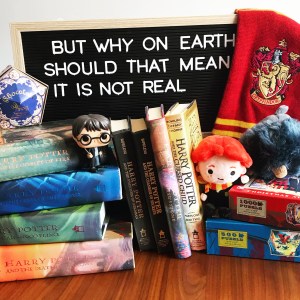
For the seventh and final day of my most impactful fantasy series: ‘To Harry Potter – the boy who lived!’
Those words concluding the first chapter of The Philosopher’s Stone launched a franchise unrivaled in the public imagination. Published in seven installments from 1997-2007, the series sold over 500 million copies and spawned eight film adaptations, a play, and a planned five-film spinoff. Harry Potter, a scrawny, bespectacled orphan with a lightning-shaped scar, endures a decade of neglect and abuse from his aunt and uncle until a booming knock at the door on his 11th birthday thrusts him into the secret community of witches and wizards. We follow Harry through his years at Hogwarts School where he navigates normal teenage pitfalls, the wonders of this new world, and the waxing threat of Lord Voldemort- the dark wizard who murdered Harry’s parents only to find his curse backfire when he turned his wand on the infant Harry.
I grew up with Harry. I was 6 when the first book was released and the same age as Harry (17) by The Deathly Hallows. My brother and I waited in the midnight book release lines (and got separate copies so we could both read immediately). I dressed up as Hagrid for the movie premiers, posing for pictures in a trench coat over a pillow with a wig and a pink umbrella. I used a quote from the series in my senior yearbook. My now-wife and I went to The Wizarding World of Harry Potter in Orlando for our first trip together in college. I choked up when I rounded the corner of the Warner Bros. Studio Tour in London to see the full Hogwarts model they used for the films. It’s been nearly fifteen years since the story ended but I still know every chapter and spell. I can’t end this post without referencing Rowling’s hurtful, if not outright hateful, comments. I promise I’ll write about them, and soon; I won’t be like Dumbledore and put off the conversation until it’s too late. But my journey with Harry himself was, cliché be damned, nothing short of magical.
Thank you all for following along! Have these series touched your life in a special way? Have your own series that you’d put on your list (fantasy or otherwise)? Let me know!
 Twenty-five Hundred Stories
One thought on “Let’s Talk Fantasy (Part 3: My Seven Most Impactful Series)”