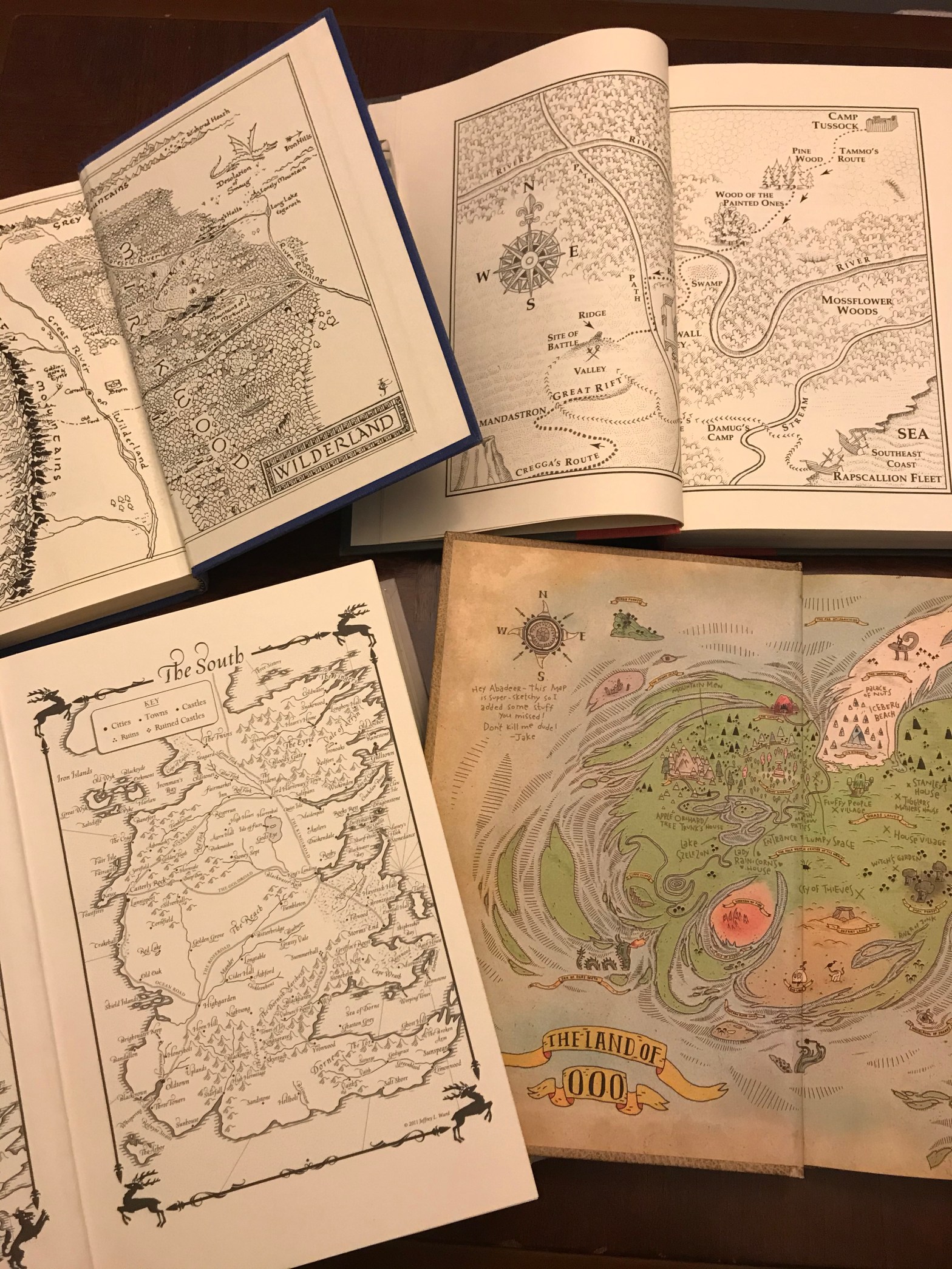
(Note: This is going to be part 1 of a longer series about the fantasy genre. I tried to fit it all into one space, realized that was absurd for a genre that makes up most of my reading, and promptly gave up. I will link other posts here as I write them)
My immediate inclination was to dive directly into what I find so appealing about fantasy as a genre and try to avoid spending too many words on myself. Saving the personal connection until the end, or tossing in a few throwaway lines here and there, keeps your arguments clearer and drives home a point without relying too heavily on what you assume are universal but instead may be individual experiences. Plus all I can think about is how often I complain about food blogs and the need to scroll through a fairly comprehensive autobiography every time you need to confirm if it was teaspoons or tablespoons. But- this post is about why I find myself drawn to a particular genre. That’s inherently personal. I kept starting and restarting this article until I realized I needed to take a step back and try it from the beginning.
In my last post I mentioned how preferences are just that- preferences. Getting someone else to love what you love is a singularly warm feeling. But go find that joy in whatever way you can. I’ll paraphrase Hobbes (with whom I’m admittedly as familiar as I am as the film Sister Act 2: Back in the Habit, which is to say not at all but I reference it all the time anyways) and say life can be solitary, nasty, brutish, and short. I don’t say that to encourage you to do your own thing all the time, others be damned. That makes life lonelier and nastier at the very least. Instead I’d hope you find joy in someone else’s passion. At a minimum, don’t condemn theirs. To wrap the lecture portion of this post- food blogger people, I was wrong. If it makes you smile, do it in whatever way makes sense for you. I know there may be ‘better’ ways to do something if you have a particular goal in mind (clicks, reviews, etc.). But if you want to give me 3000 words on your childhood memories of marshmallow fluff straight from the jar, please do.
So- me. I’d imagine most of you reading this know me and know me fairly well. If not, congratulations on making it to the third paragraph of exposition on a stranger’s blog post. But (and I’ve mentioned this before), I spend a lot of time in my own head. On the whole I don’t think it’s a bad thing. I like being thoughtful. I value people who spend time considering. I do however run the risk of getting caught in loops. If I’m upset about something, be it a friend, the news, or anything really, I’ll have that initial reaction. Then I’ll think about that reaction. And react to that reaction. And then think about that reaction to that reaction. Lather, rinse, repeat. People enjoy stories for different reasons, but one of the biggest benefits to me is stepping away from my own life for a while. All stories provide some degree of escapism, but fantasy in particular, with its spectacular settings, sweeping arcs, and world-altering events, inherently emphasizes this concept.
As I mentioned in the intro, I’m going to break my thoughts on fantasy stories into several posts. We’ll start today with two topics; nomenclature (everyone’s favorite) and why I sometimes struggle with non-fantasy fiction.
Nomenclature (where we all get on the same page)
Most bookstores and libraries lump science fiction and fantasy together on the same shelves. I’m not fundamentally opposed. Both present truly extraordinary events or scenarios, unlike standard fiction (or non-fiction, for that matter), the best of which instead presents extraordinary people. My distinction: science fiction is set in a present or near(ish) future fundamentally consistent with our current world but for a few specific advancements that could (with a little suspension of disbelief) derive from our current technology. Fantasy, on the other hand does not need that basis; things are the way there are, full stop. Magic needs rules mind you (and I will absolutely cover this in a future post), but the existence thereof is taken for granted.
Where things get a little hazy- technology gets so advanced, or the down-the-road implications so far removed, that they approach what I’d call magic. This scenario happens a lot in science fiction sequels. Hitchhiker’s Guide and Dune for instance started off as sci fi to me and quickly morphed into more traditional fantasy in later installments. Looking at my 2020 books in review, the vast and overwhelming majority are true fantasy novels. Some are ‘high fantasy,’ those set in an entirely fictional world (A Wheel of Time, Lightbringer, Stormlight, etc.). Others are ‘low fantasy,’ magical events happening in an otherwise-normal world (Harry Potter, Things in Jars, The Rook). A couple are science fiction (The Dark Forest, Cat’s Cradle) and a few fall into that in-between category where the technology is so removed that it feels closer to fantasy (Red Rising, Skyward). I say all this so when I mention these terms elsewhere in the blog, you’ll hopefully remember where I’m drawing these lines.
Traditional fiction (where I keep waiting for something to happen)
In the distant, semi-mythical past, when the office and coworkers existed as a reality outside of the occasional fever dream, my desk sat next to a writer for our communications group. A lot of the conversations centered on baseball but most of the rest would get into books or stories or general exasperation that I had no idea about the existence of the New Oxford Style Handbook. Some necessary context: I am not remotely trained in anything literary. I love stories, I look for excuses to write. But I went to a science & tech high school, majored in biomedical engineering, and worked in technology consulting for the better part of a decade. This coworker, who for the record I like very much (and who has the link to this blog), is a writer. Graduate of the Iowa Writers’ Workshop, extensive turtleneck collection, probably knows the name of each part of a sentence. I vividly remember sitting next to him one day and confessing that I sometimes struggle to get into what I called standard fiction. After his initial scoff (it was a great scoff; I’m assuming they teach it at the IWW) he tried to get me to explain.
I struggled. And I still do. I’m going to take a stab at it anyways. I’ve read some absolutely gorgeous fiction. Beautiful, poignant writing. Authors and characters who sear into my mind days and weeks and years later. But. But but but. I’m always waiting for something to happen. I feel like the kid on the tricycle in The Incredibles who after witnessing spectacular things has no patience for the mundane (no matter how beautiful the prose). I do better with historical fiction or period pieces, something to ground the story in some grand or (to me) unfamiliar environment and lend extra weight to the events. But pure fiction, a summer in the life of a twenty-something somebody in the city, navigating relationships or struggles or sex or whatever it is, leaves me wanting more. I absolutely get the allure of seeing yourself in the character. I’d argue the best fantasy takes someone with whom you can relate and puts them in spectacular situations. And the best moments in those stories are often the ‘in between’ times. Not the climactic battles but rather the friends around the campfire or the failed date or the internal dialogue about everyday, normal occurrences. But I want to feel like a story has taken me someplace wholly different. I’ll admit to feeling a little picky as I write this, but there are so many wonderful modern fantasies authors (more on them later) that I’m able to chase that immensely satisfying escape.
Do you also seek that escapism in fantasy and feel let down by more traditional fiction? Instead think I’m crazy for saying so? Have a specific topic you want me to cover when I continue this series on fantasy stories a bit down the road? Let me know in the comments or shoot me a note!
 Twenty-five Hundred Stories
2 thoughts on “Let’s Talk Fantasy (Part 1: Nomenclature and Needing a Little More)”